외국 고굴절 유리알 적용 사례
페이지 정보
작성자 최고관리자 댓글 0건 조회 696회 작성일 19-11-19 17:38본문
외국 고굴절 유리알 적용 사례
(Solidplus(고굴절 유리알 :굴절율 1.64~1.8)를 사용한 Swarco 사의 제품 성능)
Superior Road Markings with High Performance Beads :
Horizontal road marking systems consist of paints and glass beads. In a „symbiotic” relationship, the paint layer furnishes the desired colour, surface for retroreflection (RL), and retains the glass beads, while appropriately embedded glass beads provide RL and simultaneously protect the paint.
The performance of road markings plays quite an essential role when it comes to visibility, mobility scenarios such as smart driving and autonomous vehicles. Ensuring potential reduction of accidents and saving lives requires a minimum intervention policy. The European Road Federation recently proposed the 150x150 formula to maintain at all times RL>150 mcd/m²/lx and RW>35 mcd/m²/lx, (at present, in majority of cases drop of RL to 100 mcd/m²/lx is permitted).
However, SWARCO-proprietary SOLIDPLUS technology delivers enhanced performance compared with standard glass beads
Retroreflectivity values up to 1000 mcd/m²/lx
Increased retroreflection under wet conditions (RW)
Higher resistance against mechanical impacts
The capability of SOLIDPLUS in combination with waterborne paint W16 was tested in a side-by-side experiment with standard glass beads. Transverse lines, width of 15 cm, were applied at a road with Average Daily Traffic (ADT) of 7346 vehicles (including about 8% articulated lorries).After a winter exposure (0.6 million vehicle passes), the results were excellent: RL losses were only minor and both evaluated systems passed easily. After one-year (over 1.4 million vehicle passes), a further drop in RL expectedly occurred. However, SOLIDPLUS beads were still providing RL exceeding 450 mcd/m²/lx. Data extrapolation to predict a failure point has shown that road marking systems with SOLIDPLUS glass beads were employed only at 40% of its useful life.
The superior results achieved with SOLIDPLUS were also measured under wet conditions. SOLIDPLUS beads delivered exceptional wet night retroreflectivity (RW) both initially and after the winter exposure (0.6 million vehicle passes). After one year, SOLIDPLUS RW values were still very high, but a failure occurred around 1.0 million vehicle passes. The use of standard glass beads not only resulted
in lower initial RW, but also a failure occurred within only 0.4 million vehicle passes. One must keep in mind here that for Type II markings designed to meet RW requirements, glass beads with diameters up to 1400 µm are typically used, whereas in this trial beads up to only 800 µm were used.
In conclusion, road trial where a known number of vehicles passed through the marked lines has clearly shown the advantage of SOLIDPLUS glass beads over standard glass beads in terms of furnishing
exceptional retroreflectivity,
excellent retroreflectivity retention,
superior wet night retroreflectivity.
Additional retroreflectivity and durability can benefit the applicators seeking to fulfil the minimum RL requirement for performance contracts.
Several scientific reports prove that increased RL is leading to lowering the number of accidents; hence, the use of SOLIDPLUS glass beads ought to increase road safety. Furthermore, it was found that elderly focus on retroreflectivity while driving in darkness, so markings with very high RL would augment their mobility.
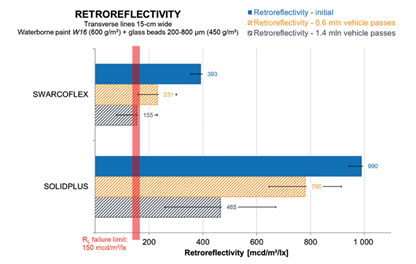
Retroreflectivity (RL) achieved with standard and SOLIDPLUS glass beads during road test.
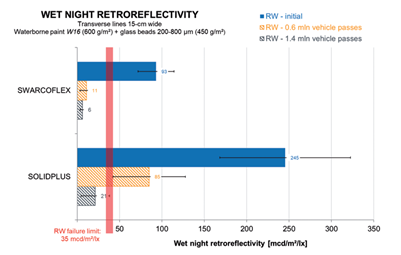
Wet night retroreflectivity (RW) achieved with SWARCOFLEX and SOLIDPLUS glass beads during road test.
Normal Glass Beads
Standard glass beads for road marking, size 100-850 µm, are prepared from milled window glass, in vertical furnaces, where at temperature of approximately 1200 °C irregularly-shaped particles become round. Their refractive index (RI) is 1.5. With standard glass beads, it is possible to achieve RL in the field of about 350 mcd/m²/lx. Various types of glass
beads, their production process and achievable results in the field have recently been reviewed (Burghardt et al., 2017). A plethora of types and qualities of standard road marking beads are available worldwide from numerous manufacturers. The produced glass beads are coated to achieve good adhesion to various base layer materials and sieved according to the customer specifications, regional demands, and various normative requirements. When needed, anti-skid particles are intermixed to assure high skid resistance under wet conditions. European norm ISO EN 1423:2013 require the glass beads to be over 80% round, free from air bubbles, and fully transparent. Content of lead, antimony, and arsenic are limited to less than 200 mg/kg.
High Refractive Glass Beads
Whereas increased RL can be readily obtained with glass beads of higher RI, their use remains a niche due to high cost
and low resistance to scratching. A solution to by-pass those limitations are premium glass beads, with RI of ±1.6 still belonging to Class A according to ISO EN 1423:2013 norm, but prepared from carefully selected virgin raw materials.
Chemical composition of such glass beads leads to the mild increase in RI and to simultaneously improved resistance to scratching. Special production process provides exceptional roundness and superior surface quality, which allows RL in the field to exceed 1000 mcd/m²/lx with white base layer and also very high RL in yellow and orange markings.
Additionally, RW of 100 mcd/m²/lx can readily be achieved. A microscope image of a narrow fraction of this type of glass beads, SOLIDPLUS brand from M. Swarovski GmbH, is provided in Fig.. Visible is their exceptional roundness; the small ‘bubbles’ and dots are just artefacts of reflecting light.
참조 : Swarco News&Reference
댓글목록
등록된 댓글이 없습니다.